For most people, quality is synonymous with greatness. It implies that the product or service was conceived using the highest standards to ensure the best possible consumer experience.
At the same time, quality is often associated with manufacturing sites, physical and chemical tests international standards (like the ISO and OSHA), and regulatory entities (like the FDA). If we look closely at various products and services, however, we can see that the importance of quality is pervasive regardless of industry—and it can make or break products and entire companies if proper steps are not taken to ensure it.
That’s why it’s important to consider quality assurance as a core process throughout the development of a video game. To this end, we will delve into how game teams can learn from some of the QA techniques used in manufacturing companies—including the importance of risk management, understanding the end user, and lifecycle management—to ultimately provide players with the best possible experience.
Risk-based approach: Acting instead of reacting
Risk is not a common word we like to use in gaming, as we often associate it with negative consequences. However, according to the ISO 31000:2018 standard on risk management, risks can also lead to positive outcomes—so we must be open to dealing with them. Some of the advantages of managing risks properly are:
- Decisions based on accumulated expertise, data, and rational knowledge.
- Improvement of the development within the current scope without further rework or resubmission.
- Reduction of post-release patches.
- Real-time quality control, reducing product testing time and resources.
By adapting some of the pharmaceutical principles above to the game industry, the key elements for effective product development using a risk-based approach are as follows:
1. The evaluation of risks in QA should be based on scientific knowledge and ultimately linked to the player’s experience.
Whether a game is open-world or any other genre, live service or single-purchase, multiplayer or single player, and regardless of whether it’s a new or existing intellectual property (IP)—we must ask ourselves how the changes we introduce or propose in QA can enhance the end user experience. This applies not only for functional QA testing, but particularly in the context of localization quality assurance. Some questions to address include:
- Have other games made similar changes in their localized vs. original versions? If so, what was the result in the market?
- If it’s a new IP, what is the developer’s main goal? Who is their target audience?
- What can we do to improve the experience for that audience?
- If there have been negative outcomes from quality issues in the past, what lessons can we learn and apply from them?
2. The level of effort, formality, and documentation of the quality risk management process should be aligned with the level of risk.
Once we have identified the potential outcomes, positive or negative, related to changes that are flagged during QA, we can begin to analyze them in a systematic way. can provide us with a framework of the whole development process. Such techniques can then help us in the following areas:
- Identifying critical development stages: What are the key steps to take during QA testing at given stages? What are the consequences of reducing time or resources?
- Prioritizing activities and resources: Does this QA testing activity make sense in the current context? How does this change add value to the product? Will the player notice a difference in the final quality of the product, compared to the original state?
It’s important to note that, even if a risk-based approach can help us organize and improve our processes, it can’t make risks disappear: these will always be present, and we must accept them as part of the process of game development. Furthermore, a risk-based approach can’t be used to bypass any legal requirements, so teams must always keep compliance and local regulatory issues in mind.
Critical to quality: Understanding the end user language
Another crucial aspect of QA that must be kept in mind at all stages is an understanding of the audience or customer’s expectations. Think about the most recent product you bought in a supermarket: you likely selected one brand over another due to a distinctive element. Every single attribute we, as end consumers, use to choose a certain brand over another one is considered a “critical to quality” attribute, and manufacturing processes or services providers use those key elements to design their products. For example:
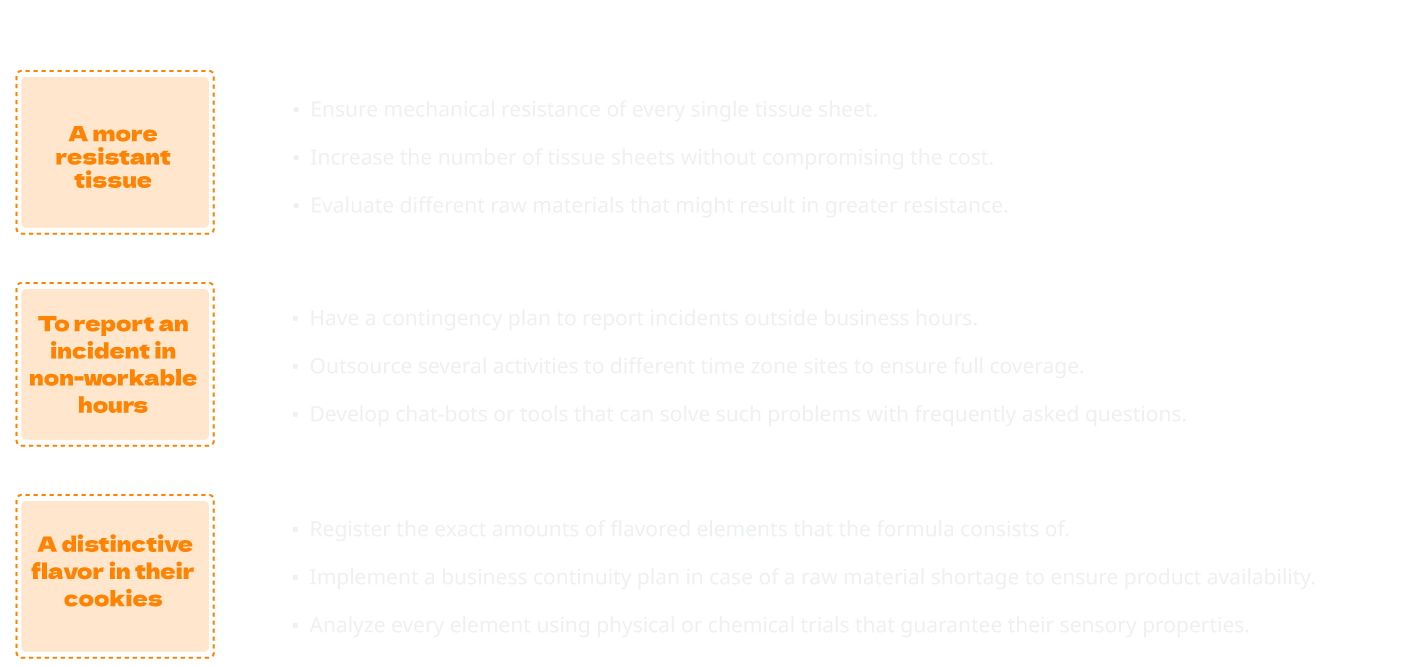
To summarize, if we can translate the end consumer’s language into processes, steps, or stages that help us guarantee the requirement, we can focus our efforts and resources to comply with them. It’s important to always keep in mind what users—in our case players—are expecting, and how we can fulfill those requirements. If a gap is then identified, it should be addressed as a top priority.
Applying this scenario to the video game industry, some examples of gaps and things to consider would be:
- If I offer the game in multiple languages, how can I ensure that they are fully and properly implemented?
- Am I confident my game is free of game-breaking defects?
- Have I considered all the legal or certification requirements?
- Can my product withstand legal scrutiny in case of controversies?
- Have accessibility options been considered, to make the game available to a wider audience?
Lifecycle management: Built to withstand time
In our current era, every single product has been engineered with specific lifecycle management in mind—from the moment we, as end users, receive it until the product or service is no longer functional. To give a simple example: when we finish a box of cereal, we can then properly dispose of the box and bag in the recycling bin for further transformation.
Video games are no stranger to this concept, since some of them require a functional online server. If we decide to decommission such a server, what will the impact be? Would further support be required if players continue to engage with the product? Furthermore, if game preservation is part of our lifecycle, and given the increasing ubiquity of digital culture, how can we ensure players will continue to have access to our products digitally?
By managing the lifecycle effectively, developers can ensure that games are not only launched successfully but also maintained and improved over time, providing a lasting and enjoyable experience for players.
Summary
Quality goes above a single step or department. It takes a village to release any new product or service into the market, and the responsibility for quality and success must be shared amongst a company and its core development partners.
We cannot allow ourselves to cut corners, since gamers expect the very best of every video game purchase. By focusing on a risk-based approach, understanding critical quality attributes from the end-user perspective, and implementing effective lifecycle management, game studios can significantly improve their QA processes as well as their outcomes post-launch. An investment in well-executed QA is ultimately an investment in your player base, increasing your chance of loyalty for years to come.