
For Yuxuan Gao, a QA Test Lead at Side Shanghai, the journey from programmer to Quality Assurance specialist revealed a truth that many studios in the industry often overlook.
After spending four years as a programmer at an indie studio, Yuxuan discovered that the skills needed to write good code and the skills needed to ensure a great player experience are fundamentally different – yet many studios still expect developers to handle both. This realization came not from theory, but from hands-on experience watching "perfectly coded" games fail to deliver the smooth, intuitive experiences players expect.

Industry Challenges
In recent years, the industry has seen a string of highly anticipated games flop at launch under a flood of negative reviews. For Yuxuan, the pattern is clear: "When you dig deeper, it's often the same culprit – bugs, and lots of them."
In his view, this points to a widespread issue across both AAA giants and indie teams: the over-reliance on programmers doubling as quality assurance testers, essentially underestimating the value of dedicated QA professionals. The thinking is that since developers know the code inside out, they're also perfectly suited for testing the game. However, this idea doesn't match reality. Unless a programmer has professional training or years of QA experience, they're simply not equipped to do the job well.
"There's also a stigma surrounding QA testers," Yuxuan continues. "Some people still think QA work is low-skill, that you can just toss a controller to a random gamer and call it a day. But that's like saying anyone who eats food can be a food critic."
As a programmer who spent four years at an indie studio, even Yuxuan was initially skeptical about QA's complexity. "I, too, used to underestimate QA work," he admits. "It wasn't until I tried doing it myself that I realized how much of it goes beyond the code."
The Issue with Leaving QA to Coders
While the two professions overlap on some levels, they're fundamentally quite different. According to Yuxuan, developers without QA experience tend to have tunnel vision because they analyze problems purely from a code perspective – overlooking the designer's creative intent and players' real experience.
"Sure, casual players can spot obvious bugs," Yuxuan explains, "but proper testing requires serious know-how, like simulating newbie misclicks, stress-testing edge cases, or anticipating nightmare scenarios streamers might encounter during live broadcasts." He continues, "Things like awkward UI interactions or poor stat balancing might not trigger a crash, but they can absolutely tank the player experience."
Failing to catch these details can result in non-programmatic bugs slipping through the cracks.
What Are Non-Programmatic Bugs?
Non-programmatic bugs are exactly what they sound like: the code executes perfectly, doing exactly what it was written to do. However, what players end up with is a game that runs flawlessly under the hood but just doesn't feel good to play.
Yuxuan offers a real-world example:
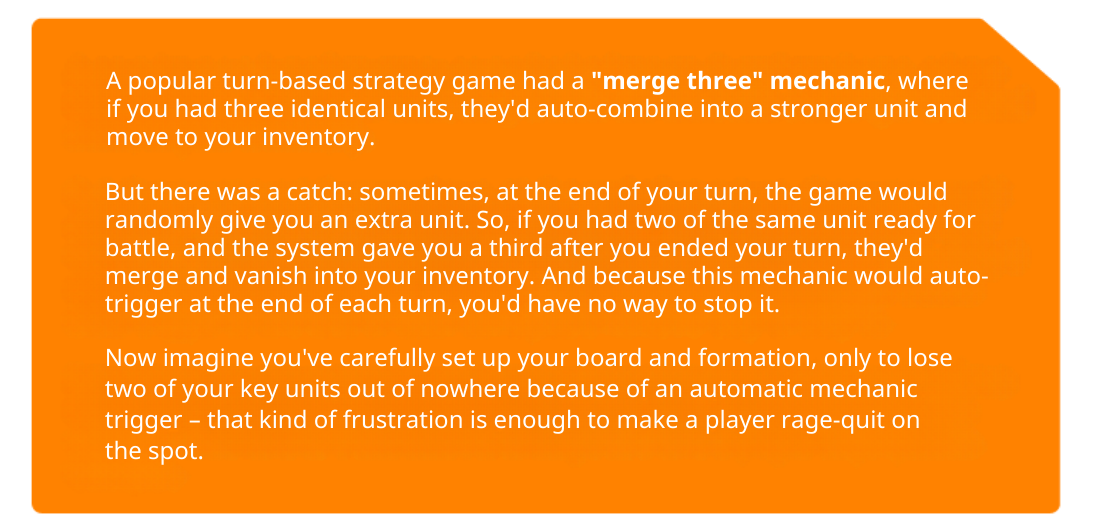

From a code logic standpoint, it did exactly what it was supposed to do. But for the player, losing key units mid-battle without warning was a disaster.
Eventually, the developers fixed the issue. They added a condition to prevent the merge from triggering during end-of-turn effects, delaying it until the start of the next round instead.
QA Is All About Prioritizing the Player Experience
A professional QA tester doesn't just look for broken code: they spot broken design and anything that gets in the way of a great gaming experience. In many cases, a programmer doing QA is often blind to anything that isn't a code-level bug.
That's why QA work can't be solely left to programmers – it takes a dedicated QA team to do it right and spot issues like the one illustrated in the “merge three” example.
"It's like the difference between an architect and a home inspector," Yuxuan notes. "The architect makes sure everything is built to spec, while the inspector checks if the door handle height feels natural and whether the fire exit signs are visible through thick smoke."
The Future of QA in Gaming
Fortunately, more studios are starting to appreciate the value of proper QA. These days, many will not only run regular QA cycles but even bring in their QA teams for full playtests before launch, double-checking everything from a technical, design, and user perspective.
And as that "merge three" fix demonstrated, when clean code and smooth user experience don't align, it's QA's intuition that saves the day. After all, games live and die by player feedback.
Yuxuan's transition from programming to QA reflects a broader shift happening across the industry. As more studios recognize that great games require both technical excellence and player-focused design, the role of dedicated QA professionals becomes increasingly vital.