
What Is the State of AI in Game Localization?
Game development is moving as fast as ever. With studios pushing weekly updates to meet global player expectations, AAA and indie games alike face pressure to launch simultaneously across multiple markets.
In this environment, localization teams are turning to AI solutions like LLMs, agentic workflows, and quality estimation tools to scale their output and efficiency while maintaining quality standards.
Below, we examine where AI localization technology really stands today, covering what currently works, what doesn't, and where we see the most promise for game teams looking to balance speed, quality, and cost in their localization processes.

Agentic Workflows in Game Localization
Across our teams and the wider industry, artificial intelligence is being tested and implemented in virtually every aspect of game development. Among these implementations, agentic workflows represent one of the most significant developments.
In the context of game localization, agentic workflows refer to the use of multiple autonomous AI agents that oversee, manage, and execute a chain of tasks. Currently, these systems are used in tasks like content triaging, glossary QA, metadata tagging, and of course, translation. For simpler tasks, they’ve proven to work quite well.
However, reliability, quality, and efficiency tend to drop when workflows become more complex and creative. There are a few reasons for this:
- Chain fragility: The more agents you put in the flow, the higher the risk of mistakes. If one agent in the lineup makes an error or misinterpretation, it breaks the whole chain.
- Training complexity: Many professionals struggle with basic AI prompting. They’re not familiar with how to write effective prompts, manage context windows, or iterate on outputs. Agentic workflows require orchestrating multiple specialized agents, each needing different instructions, parameters, and quality thresholds. Without solid fundamentals, teams end up with poorly configured workflows that fail unpredictably.
- Organizational scaling: Implementing at scale (especially where different departments are involved) multiplies this complexity. If you don't have established coordination between departments already, then setting up agentic workflows can be even more difficult.
Agentic Workflow: Chain Fragility Example
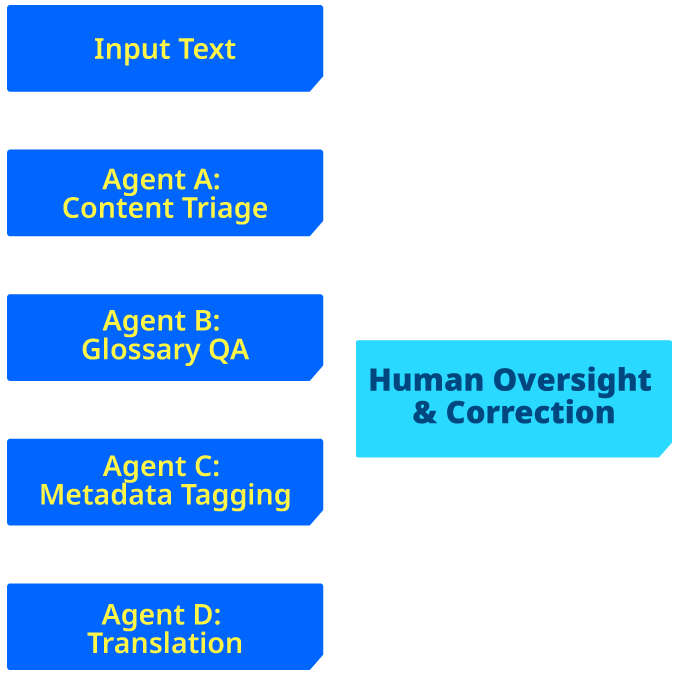
To address these challenges, realistic expectations and careful implementation are required. The key is understanding each workflow’s limitations and choosing the right technologies for your specific game content.
From MT to AI in Game Localization
Within AI-powered localization workflows, there are two main translation technologies used today: Large Language Models (LLMs) and Neural Machine Translation (NMTs). Each offers unique advantages and challenges. Which should you use for your game content?
NMTs
Neural Machine Translation engines like DeepL and Google Translate have several key advantages that make them the preferred choice for certain content types. They're highly predictable and consistent – translate the same text multiple times and you'll get identical results. Their reliability makes them ideal for menus, static UI elements, support documentation, and other content where consistency is more important than creativity.
These systems are also highly customizable for specific workflows and language pairs, with Translation Memory integration making them particularly powerful for game sequels and ongoing content updates. The combination of speed, cost savings, and data security has made NMTs an essential component of modern localization workflows.
However, their strength can become a limitation when dealing with creative content. Translations from NMT engines tend to be literal and robotic because these systems can't be instructed or prompted like LLMs. They're trained on specific datasets and produce translations based on statistical patterns rather than contextual understanding.
While NMTs still play a central role in localization workflows, as content demands become more creative and complex, many developers have begun leaning toward Large Language Models for dialogue and narrative elements.
LLMs
Large Language Models like GPT-4, Gemini, and Claude, on the other hand, excel at handling creative dialogue, narrative content, and culturally nuanced translation. Because they can follow detailed instructions to tailor their output, they can adapt their tone and style to match specific character voices or brand guidelines.
However, they’re not without their challenges. Consistency remains a major hurdle. Even with carefully prepared prompts and glossaries, LLMs can translate the same term differently across pages. What’s more, while LLMs handle creative text better than traditional machine translation, they often fall short of truly natural-sounding results. In many cases, the translations are correct and follow instructions, but still sound robotic.
Content Suitability Matrix for NMTs and LLMs, with Human Post-Editing
| Content Type | Optimal Tech | Explanation |
| UI Text / System Messages | ✅ NMT | Short, functional, context-based text |
| In-Game Instructions | ✅ NMT | Structured, repetitive, and instructional |
| Quest / Task Descriptions | ⚖️ NMT + LLM | Patterned content, requires light refinement |
| Item / Skill Names | ⚖️ NMT + LLM | Requires consistency review |
| Dialogue / Narrative Content | ⭐ LLM | Need character references and lore to train LLM, ensuring emotional depth and nuance |
| Voiceover Scripts | 👤 Human Only | Must sound natural, fit timing constraints |
| Marketing / Promotional Content | 👤 Human Only | Requires creativity & transcreation |
With both approaches having clear limitations, automated quality evaluation becomes crucial for scaling AI translation, which is where Quality Estimation enters the picture.
Quality Estimation (QE)
Quality Estimation (QE) is an AI system that automatically evaluates translation quality without human reviewers or reference translations. It assigns confidence scores and flags potential issues, allowing high-quality translations to flow toward publication while routing problematic ones for human review.
This technology is already at work in some industries: for example, e-commerce has successfully implemented QE based on established models and predictable content patterns. QE has gained considerable industry attention, with different models being ranked and compared at conferences like LocWorld.
Quality Estimation Workflow Example
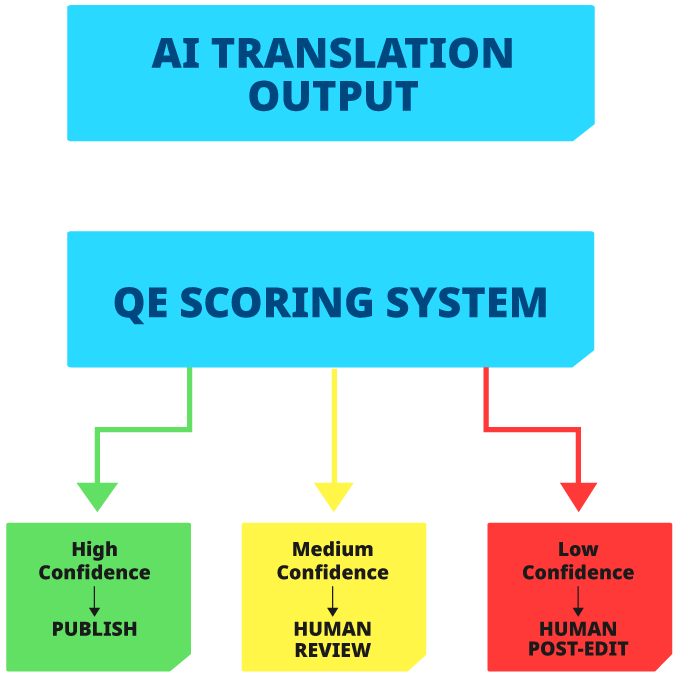
However, game localization presents unique complexities that current QE systems struggle to handle. The sheer variety of content, combined with different working styles, means each game would require custom QE calibration rather than using standardized models. This leads to too many false positives, where QE systems flag non-existent issues or miss contextual problems that human reviewers would catch immediately.
The underlying challenge is data. QE systems rely on LLMs trained on generalized datasets rather than game-specific content. While custom-trained models could perform better, this raises legal and commercial concerns about what data can be legally used for training.
For now, QE in game localization remains more promise than reality. The complexity and creative demands of game content mean human expertise remains irreplaceable for quality assurance, which is why…
The Human Element Remains Essential
While AI systems show promising capabilities, human expertise and oversight remain crucial in game localization workflows. You need people to train and improve AI systems, communicate between teams, and provide localization quality assurance (LQA).
People bring cultural perspectives that AI cannot replicate. They understand content in context, catch issues that automated systems miss, and can determine when a game truly feels natural to players in each target market.
A Unified Approach: RESOLVE
The most effective localization workflows combine AI efficiency with human expertise. Our RESOLVE solution for localized Player Support is one example that integrates agentic workflows, LLMs, NMTs, quality estimation, and human oversight into one unified system.
RESOLVE dynamically selects the optimal translation engine (Google Translate, DeepL, ChatGPT, etc.) per language pair. The system continuously monitors translation quality through BLEU scoring and proprietary algorithms, automatically routing subpar outputs to human post-editing. When automated quality thresholds aren't met, human experts fix translations and provide feedback that improves future outputs.
Most importantly, RESOLVE handles the organizational complexity that makes agentic workflows fragile. Rather than requiring teams to orchestrate multiple specialized agents, the system manages tool selection, quality estimation, and human escalation automatically – delivering the efficiency gains of AI without the overhead that typically derails implementation.
Learn more about the tech behind our RESOLVE solution here.

Finding Your Path Forward
The promise of AI in game localization is real, but so are its current limitations. Agentic workflows break down as tasks become more complex, LLMs are creative but inconsistent, NMTs excel in their narrow domains, and quality estimation systems aren't yet ready for game content. However, despite these limitations, each system still has value to offer. Rather than waiting for these technologies to mature individually, the opportunity lies in thoughtful integration.
Studios and teams succeeding with AI localization have embraced exactly this approach – they're not implementing every new tool, but understanding how to combine AI efficiency with human expertise strategically.
Wondering what the best approach is to localize your game?
We specialize in AI localization technology, building custom workflows, and integrating tools effectively for a wide range of clients from indie to AAA. If you have questions about tools, timelines, or technical feasibility, connect with our team!