Why Game QA Sets the Standard for Modern Software Testing

Published: 2026年8月12日

Author: Sujesh Mithran, Senior QA Manager and Rajdeep Sahani, Solution Architect Manager

Why Game QA Sets the Standard for Modern Software Testing

Key Takeaways

  1. Beneath the fun, games are extremely complex: Games run on some of the most sophisticated software ever built – physics engines, live services, platform certification, and continuous updates – all operating simultaneously, across thousands of hardware configurations.
  2. That complexity shapes more rigourous QA: Exploratory over scripted, systems-thinking over modular, and human judgement where automation falls short.
  3. What works in games works in software: As software outside games becomes more interconnected, real-time, and experience-driven, the discipline built for games is becoming the standard it needs to meet. 

There's a discipline in the games industry that the broader software world is only beginning to appreciate. 

Games are entertainment, but building and testing them is anything but casual. Underneath every player experience is a dense, real-time network, where a single change can cascade across the entire system.  

Testing software at that level demands a team that understands the intricacies of these systems and how to test them. 

This article breaks down what makes video game QA services different, why that difference matters to software teams outside of games, and how the lessons learned in one of the world's most demanding testing environments are directly applicable to other industries. 

Why Are Modern Video Games So Complex to Test?  

To understand why Quality Assurance testing for video games is different from typical enterprise software, you first have to understand what games are actually made of. 

Games don't just run on one system. They run on many – simultaneously, interdependently, and under conditions that change with every player interaction.  

Let's break down what’s under the hood. 

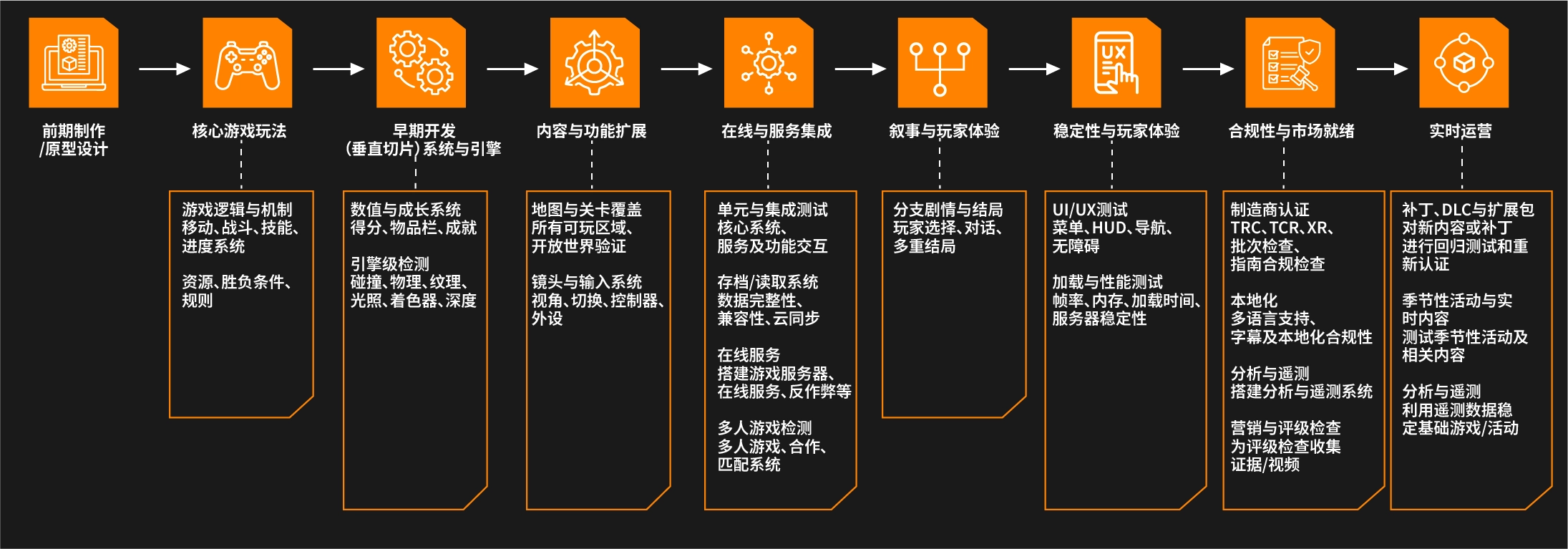
Diagram illustrating the complexity of modern game testing across the development lifecycle, from pre-production and core gameplay through systems integration, online services, player experience, compliance, and LiveOps, with each stage showing the different QA areas and checks involved.

Systems & Engine Complexity 

Physics, collision detection, rendering pipelines, textures, shaders, lighting, frame rate, and memory constraints don't operate sequentially or in isolation. Modern AAA titles regularly exceed 100GB in size, with open-world games containing millions of lines of code – all running continuously, across thousands of hardware configurations, each with different performance ceilings. This is real-time performance engineering under extreme constraints. 

Built on top of that foundation is an equally complex layer of gameplay systems.  

Interconnected Gameplay Systems 

Game logic, AI, stats and progression, inventory, save/load systems, and multiplayer interactions all operate together in real time. The output of one gameplay system often becomes the input for several other systems simultaneously. A single bug can produce cascading effects throughout the game, significantly increasing the number of possible test combinations and edge cases. 

An issue involving incorrect damage output, for example, may initially appear to be a UI or balancing problem, but the root cause could lie within combat calculations, animation timing, status effects, or a host of other systems entirely. Even a simple display bug can have hidden side effects elsewhere in the game. 

Content Explosion & World Scale 

Games often allow players to approach objectives, progression, combat, and exploration in multiple ways, creating a far wider range of possible interactions. Map and level coverage, open-world validation, branching narratives, and multiple player outcomes mean there is no single path through a game. Players rarely interact with games in a fixed or intended manner – they make unexpected choices, combine mechanics in unintended ways, and reach interactions that structured testing would never surface. Procedurally generated worlds and AI-driven NPCs add another layer of unpredictability, too.  

The broader and more open the game world, the wider the gap between intended use and actual use. 

Online & Services Integration 

Modern games are live service ecosystems. The most popular multiplayer titles need to handle millions of concurrent players simultaneously – all expecting real-time responses and uninterrupted service. Behind every multiplayer match is a network of servers, matchmaking systems, anti-cheat infrastructure, and cloud sync, all handling concurrency, latency, and network failures at the same time. Minor issues in any of these systems can bleed across gameplay, progression, and player experience. 

Each platform manufacturer also has its own certification requirements for multiplayer functionality, covering matchmaking flows, session management, disconnection handling, and recovery from network interruptions. And unlike single-player systems, multiplayer environments require multiple users, devices, and servers to interact seamlessly in real time. 

Stability & Player Experience 

Amidst all of the interconnected systems, unpredictable behaviour, and platform requirements is a low user tolerance for failure. Latency can destroy engagement. A crash mid-session loses progress and erodes trust. Failure is public and immediate. 

UI/UX, performance, load, and server stability all feed directly into how a player experiences a game. 

Compliance & Market Readiness 

Before a game reaches players, it must pass platform certification. TRC, TCR, and Lotcheck – the technical requirements mandated by Sony, Microsoft, and Nintendo respectively – introduce a layer of verification that goes well beyond functional testing. These certification processes ensure that the game is stable and capable of delivering a consistent user experience across the platform ecosystem. 

Beyond platform certification, games must also satisfy global regulatory requirements, cultural localisation scrutiny, and marketing and rating standards across every territory they ship in. Failure in any of these areas means rejection and a delayed release. 

LiveOps 

Shipping a game doesn't mark the end of QA. In live-service titles, it marks the beginning of a different kind of pressure entirely. Patches, DLC, seasonal events, and balance changes mean the product is continuously evolving – and every update is a regression risk across tightly coupled systems. Adding or modifying content in one area can unintentionally affect progression systems, matchmaking, in-game economies, and multiplayer services simultaneously. 

The product never stops evolving. Neither does the obligation to maintain its quality. 

Quotes

“Players rarely interact with games in a fixed or intended manner – they make unexpected choices, combine mechanics in unintended ways, and reach interactions that structured testing would never surface.”

Why Is Game QA Different From Traditional Software Testing? 

Traditional QA was built for predictable software. Defined user journeys, stable requirements, modular systems where a defect in one place stays in one place. Validate the business logic, test the forms and APIs, confirm the transaction flows. It's a structured, repeatable process, and for the software it was designed for, it works. 

Games operate in a different environment entirely. And the QA discipline built around them reflects that. 

Exploratory Over Scripted 

In most enterprise software, predefined test cases cover the majority of meaningful user interactions. In games, they're a starting point at best. Players don't follow intended paths, and scripted test cases can't account for where they'll go.   

This is why game testing depends heavily on exploratory testing. QA testers have to think like players – they have to experiment, improvise, and deliberately try to break things in ways that structured testing would never reach. Hidden bugs, balance issues, gameplay exploits, and system interactions that only emerge under real player-like conditions are what exploratory testing exists to find.  

Systems Thinking, Not Module Thinking 

The interconnected nature of video game software means that end-to-end validation across multiple systems is required simultaneously. A defect observed in one area may originate from an entirely different subsystem. And fixing one issue can lead to several others. Testing from multiple angles – across multiple scenarios, hardware configurations, and network conditions – is the only way to surface what scripted test cases miss.  

That requires a different kind of tester who understands how systems interact, thinks in terms of downstream impact, and treats regression testing as a continuous discipline. Performance testing in real-time environments requires a combination of automated tools and human-driven testing to evaluate how systems perform under realistic usage conditions. It requires cross-functional collaboration between QA, development, and live operations teams – because in games, quality is never one team's responsibility alone. 

Emotional Experience as a Validation Layer 

Unlike traditional software, games are designed to make players feel specific emotions. Different genres aim to create different experiences. For instance, horror games are meant to create fear and tension, while tactical FPS games induce panic and pressure. Without these emotional elements, a game can feel bland, repetitive, or unengaging. 

As part of validation, QA teams assess not only whether the game functions correctly, but also whether the gameplay, audio, visuals, pacing, difficulty, and immersion systems deliver the intended emotional experience. This makes subjective evaluation an important part of game QA – where testers analyse and report if the game lacks engagement, emotional impact, or immersion from a player-experience perspective. 


From Games to Enterprise – Side's Journey 

Some of the people Side has worked with longest in games have since moved into roles across tech and enterprise. When they did, they encountered a familiar problem: traditional software testing services weren’t sophisticated enough. They lacked the exploratory thinking, systemic stress testing, and rigour these individuals had come to expect from game QA.

So, they came back to Side.

Everything they needed from process maturity, structured testing frameworks, and high-pressure release discipline to cross-platform validation and certification readiness was already in place. A discipline built for the most demanding software environment that exists, applied to theirs. 

The result was releases that were smoother, more stable, and better understood before they reached users. Not because the approach was new – but because it had already been proven. 

The Rise of Gamified Systems In Enterprise Software  

Why is enterprise software increasingly becoming more game-like? 

Organisations are introducing personalisation, reward systems, leaderboards, completion milestones, and real-time interaction to drive engagement and retention.  

But the more significant shift is structural. As software adopts game-like mechanics, it inherits game-like complexity. The principles translate directly: 

EdTech  

Progression validation, personalisation engines, and achievement systems require the same interconnected validation thinking gaming QA applies as standard. Testing whether a quiz unlocks correctly after a required lesson, or whether a progress score is recorded accurately across devices, is a games-adjacent problem. 

IoT  

Multiple devices, variable network conditions, asynchronous events. Testing a smart thermostat that must reconnect after a Wi-Fi drop and still report the correct temperature state is the same class of problem as validating game state recovery after a network disconnection. 

AI Systems  

Unpredictable outputs require exploratory, behaviour-driven validation. Testing whether a chatbot gives safe, relevant answers when a user asks the same question in conflicting ways requires the same mindset game testers apply daily. 

Automotive  

Real-time interaction, safety-aware validation, behaviour under interruption. Confirming navigation, media playback, and Bluetooth pairing recover correctly after a vehicle restarts mirrors game state recovery validation. 

The crossover runs deeper than methodology – the technology itself has already made the leap. The engines built for games are now powering automotive human-machine interfaces, digital twin simulations, and military flight training. For instance, Lockheed Martin is using Unreal Engine to train fighter pilots.  

As Adam Breed, Strategic Technologies Architect at Lockheed Martin put it: "Game-engine technology has advanced so fast" that the lines between entertainment and mission-critical simulation "have now blurred significantly."  


Built in Games, Available Everywhere 

Games run on some of the most sophisticated software ever built. Game QA has had to match that standard, evolving into one of the most rigorous and battle-tested testing disciplines in the industry.  

Side has been at the centre of that evolution for over 30 years, partnering with AAA and indie studios on some of the world's most demanding releases. That expertise is now available beyond games. 

Think your software could benefit from this approach? Let's explore it together. 

Tags