
Building a video game takes talent, time, and more moving parts than most teams can manage alone. That's why many game studios turn to outsourcing, otherwise known as external development – but doing it well requires more preparation than you might think.
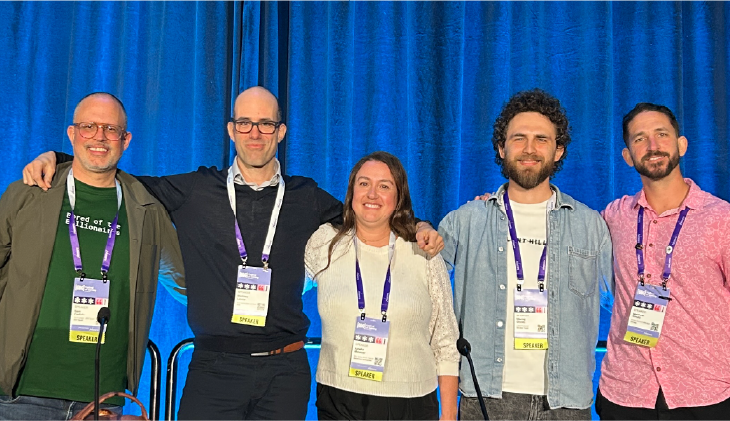
At GDC Festival of Gaming 2026, insights were shared by Side's Mathieu Lavoie, Senior Director of Music and Sound – joined by leaders from XDS (Sam Carlisle), Behaviour Interactive (Amelie Meunier), Bloober Team (Maciej Glomb), and Virtuos (Matthew Schulz) – in a session that discussed what separates partnerships that thrive from ones that quietly drain time, money, and goodwill.
Below, we summarize the key takeaways they shared on how to foster smarter collaboration with external development teams – and what happens when you don't.
Why Outsource?
Studios typically turn to outsourcing to fill gaps or handle production spikes. At its best, though, it does more than that. It strengthens how your team operates in three key ways:
1. De-risking: Managing Volatility
Game development is rarely linear. Most studios maintain a core internal team, then scale up for specific phases and pull back when they’re complete. External partners give you the flexibility to do that without the overhead of constantly hiring and restructuring.
However, that flexibility only works if the relationship is handled honestly. When budgets are squeezed too aggressively, or scope is downplayed to secure better rates, the pressure doesn’t disappear – it shifts to the vendors who absorb the difference, and the impact shows up later in quality or in a sense of broken trust.
Outsourcing can reduce risk, but not if that risk is simply transferred to your partner. Clear expectations and realistic scoping upfront lead to better outcomes on both sides.
2. Sustainability: Protecting Your Team
Sustained production pressure is one of the biggest challenges studios face. When internal teams are expected to absorb every spike in workload, burnout becomes difficult to avoid.
Planned external support acts as a pressure valve: it gives teams the capacity to handle peak periods without constant escalation and creates a psychological sense of safety during heavier phases of development.
Timing also matters. Support introduced late, when teams are already under strain, can add complexity instead of relieving it. Outsourcing works best when it’s treated as a health plan: something you put in place before you need it, so your team knows it's there when they do.
3. Skill-Set Expansion: Strengthening Capability
Modern game development spans too many disciplines for any one team to be elite at everything. In an external development model, partners provide access to specialized expertise without the cost and time required to build it internally.
But the strongest partnerships go beyond simply executing a brief: they create opportunities for knowledge transfer, where internal teams gain exposure to new approaches, tools, and ways of working that persist beyond the engagement.
That said, dependency is a real risk. If too much responsibility shifts externally, internal growth can stagnate. The goal isn’t to replace internal capability – it’s to amplify it.
Quotes
“Outsourcing works best when it’s treated as a health plan: something you put in place before you need it.”
How to Make It Work
Understanding why to invest in external development is one thing. Making it work in practice comes down to how the partnership is set up and managed.
Plan Before the Pressure Hits
Outsourcing decisions are often made reactively, when deadlines are approaching and teams are already stretched. At that point, your options are limited.
Planning your needs ahead of time – across all phases of development, not just the ones currently on fire – changes everything that follows. Studios have more time to define scope properly, select the right partner, and integrate them effectively.
For live service games in particular, external development mandates should sit alongside the product roadmap from the start.
Define What Success Looks Like
Clarity at the start determines how the partnership performs later. Be specific about what you need: short-term support or long-term collaboration, staff augmentation or full production ownership. This shapes everything from partner selection to contract structure.
Your project brief should define success criteria with measurable outputs and concrete examples. The more precise the brief, the easier it is for a partner to deliver against it.
Find the Right Partner
The best partners don’t mirror your team – they complement it. Look for expertise you don’t already have, along with a working model that fits your production.
Define roles and responsibilities early. Establish who owns decisions, what requires escalation, and what can move forward independently.
Teams that feel like they’re building something with you – not just delivering against a brief – tend to perform at a higher level.

Onboarding Sets the Pace
Even with the right partner and a strong brief, poor onboarding can stall progress.
Focus on three areas:
- Infrastructure: Tools, access, and documentation must be ready before work begins.
- Alignment: Kickoff should clearly define goals, workflows, and communication.
- Integration: External teams should be embedded into existing pipelines, with clear ownership on both sides.
Communicate Early, Not Perfectly
Most issues in outsourcing partnerships don’t come from lack of communication, but from timing. Problems raised late are harder to fix.
Regular syncs, consistent feedback loops, and transparency matter more than waiting for complete information. Feedback should move both ways – external partners can often provide valuable perspective on your process.
Also important to note is that, when working across diverse regions and time zones, communication gets even more complex. In some cultures, feedback is direct and immediate. In others, it’s more measured, or only raised once a solution is proposed. Silence can easily be mistaken for alignment when it isn’t.
Effective collaboration requires adapting to those differences. Setting clear communication expectations upfront, encouraging early escalation, and taking time to understand the diverse cultural norms you are working with will save you from a lot of misunderstandings in the long run.
Alignment Starts Internally
One of the most common points of failure has nothing to do with the vendor.
Internal teams often don’t have visibility into what was agreed – scope, budget, or constraints. That gap creates unrealistic expectations. Requests accumulate, iterations expand, and budgets are used up faster than planned.
The result is friction that gets directed externally, even when the partner is delivering exactly what was contracted.
Avoiding this requires internal clarity:
- Make sure teams understand what was purchased and how budget is being used
- Centralize requests and manage scope actively
- Know when work is complete, and avoid over-iteration
- Plan for trade-offs, accepting that not everything will make the final cut
Outsourcing failures are often internal alignment issues before they are external execution problems.

Case Study: Silent Hill 2 Remake
Bloober Team’s experience with external development on the Silent Hill 2 remake offers a clear view of how assumptions break down in practice – and what teams can learn from it.
As a first-time large-scale outsourcing effort, the team expected budget approval to be a constraint and initially focused on tightly scoped, self-contained tasks. In reality, external budgets were easier to secure than internal headcount, which shifted the challenge toward identifying where outsourcing would have the most impact.
More importantly, many early assumptions didn’t hold once production began:
|
Assumptions |
Reality |
|
We want to embed the outsourcing teams as much as possible. |
Lack of documentation caused a lot of inefficiencies. |
|
We expect to receive what we asked for. |
Gated communication often led to undesired results. |
|
We expect to fit in the milestones we've set. |
We often didn't accommodate for an onboarding period. |
|
We will all get along. |
We didn't. |
The adjustments and lessons that followed are what made the difference:
- Be upfront about budget and constraints
- Identify outsourcing needs early, based on dependencies
- Embed partners into your team – but support that with proper documentation
- Prioritize onboarding and give partners the tools to work independently
- Know that it’s okay not to vibe with someone – it goes both ways
The takeaway isn’t that outsourcing is unpredictable – it’s that most of the friction comes from assumptions made too early, and not revisited quickly enough.

Build It Right from the Start
Outsourcing is a design choice that touches every part of how a game gets made – budget, people, quality, and culture.
When it works, it makes studios more resilient, more capable, and better equipped to deliver. When it doesn't, the reasons are almost never about talent, but rather about structure: how the partnership was planned, how teams were onboarded, how communication was managed, and whether everyone was working from the same page.
Getting that structure right is what separates partnerships that drain resources from ones that move the needle.
At Side, we've spent over 30 years working with developers and publishers of all sizes, creating lasting partnerships and helping them bring their vision to life.
If your next project needs a partner that's invested in getting it right, we’d love to connect.