
Player support can make or break your game's success. How quickly and effectively you resolve player issues directly influences their relationship with your game and studio.
But not all players invest the same amount of time and money into your game. In most live-service titles, a small fraction of highly engaged players drives a disproportionate share of revenue and long-term value.
The exact percentage (roughly 1-5%) varies by game, genre, and monetization model, but the underlying pattern is consistent: a tightly concentrated core of dedicated players sustains the ecosystem, shapes community norms, and amplifies both positive and negative experiences far beyond their own spend.
That's where VIP player support comes in. It's not just about making your most engaged players feel appreciated. At its best, it's a comprehensive system that recognizes and nurtures your most engaged players, anticipates friction points before they become problems, and creates pathways for more players to reach that same level of investment.

What Does VIP Player Support Actually Mean?
VIP support is the focused, high-touch arm within your broader player relationship management framework.
At its core, it’s designed specifically for players with higher levels of engagement and investment. These players have fundamentally different needs, expectations, and value to your business and game.
In practice, VIP support can include:
- Faster response times
- Personalized treatment from agents who understand a player’s history
- Convenient and dedicated communication channels (live chat, email, social media, self-service)
- 24/7 human-only contact
- Exclusive perks
But who exactly are your VIPs?
Identifying Your VIP Players
Put simply: they’re players who can’t get enough of your game. They’re the ones with exceptionally high session counts and session lengths. The ones who are in your game every single day, for hours at a time. They're typically in the top 1-5% of spenders in your game, consistently engaging with limited-time events, unlocking high-tier cosmetics, and buying expansions.
But spending alone doesn't tell the full story – some of your most valuable players are community leaders, guild anchors, and content creators who amplify your game's reach beyond their own playtime. They recruit friends, moderate Discord servers, defend your brand in forums, and create the kind of organic marketing that money can't buy.
Regardless of what drives them, the unifying thread across all VIPs is emotional attachment. Your game is part of their daily routine, their social circle, and in some cases, their identity. They don't just play your game, they're invested in its success.
Building Lasting VIP Relationships
Building relationships with these players is crucial to creating the emotional attachment that makes your game feel special.
Modern VIP support isn't just “typical ticket handling but quicker”. It’s about delivering the right level of support to the right players. Doing that at scale means creating a proactive, data-driven system built wholly around identifying, nurturing, and retaining your most valuable players.
An effective VIP support system typically rests on the following four pillars:
 1. KNOW YOUR PLAYERS
You can't manage what you don't understand. The first pillar establishes the intelligence layer of the system.
Build a unified player database
Since VIPs spend a lot of time playing your game, you’ll want to track certain player metrics like session frequency, engagement with key features, device and source information, purchases, and historical trends.
You should also track what motivates them by identifying engagement patterns, spotting friction points where they struggle, and monitoring sentiment signals that indicate satisfaction or frustration.
The aim is to build a complete picture of how each player interacts with your game.
Segment players into dynamic personas
Next, using the dataset you’ve constructed, you can segment your players based on behaviors, motivations, and engagement styles.
We typically categorize players into various personas such as:
- Feedback-driven players, who want to help improve your game
- Exploratory players, who chase every new feature
- Community-oriented players, who build social connections
- Competitive players, who value rankings and achievement
- Creative players, who love generating content or customizing their experiences
Of course, there will be some overlap, since not every player fits neatly into one category. But by mapping personas, you can start to design support strategies around specific motivations, enabling you to anticipate player frustrations and address them before they escalate into deal-breaking issues.
 2. ANTICIPATE NEEDS
For your top 5% of players, churn is too costly to treat reactively. That’s why it’s crucial to catch the earliest signs of disengagement and intervene before momentum is lost.
Sharpen your predictive capabilities
Your anticipation strategy should include churn prediction models – Decision Trees, Random Forests, Neural Networks, or Survival Analysis – to identify high-risk users in real-time.
These models flag early warning signals (such as a player who usually logs in daily suddenly goes three days without playing), and trigger retention tactics that you’ve tailored to the situation. This might mean incentives to re-engage, UX improvements that address friction points, or proactive outreach from your support team.
Note: Just don’t forget to track and A/B test to see which interventions are most effective, and refine your models based on the results!
 3. PERSONALIZE AT SCALE
Whether it's executing on your retention strategy or helping someone with a ticket, what really makes players feel like VIPs is personalizing their experience. Delivering support in a player's language, understanding how they feel, and being familiar with their profile history helps make them feel appreciated and lets them know they're in good hands.
Structure support through tiers
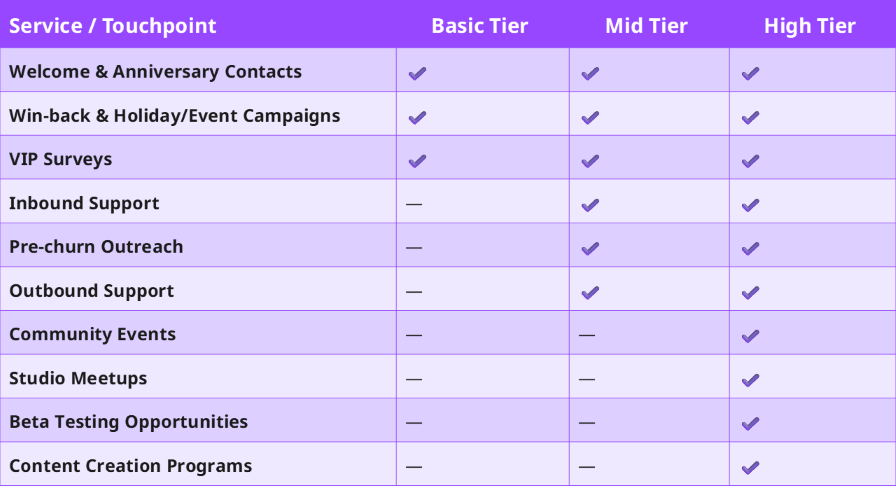
Managing a large and diverse player base requires a systematic approach. We've found that breaking your VIPs into different tiers (based on player engagement) balances support efficacy with that personal touch.
Lower tiers focus on foundational touchpoints like surveys and campaigns, mid-level tiers add proactive support and outreach, while top-tier players gain access to exclusive experiences like content creation programs and studio meetups.
Below is a sample support tier system:
Make it work at scale
In today’s global gaming landscape, delivering personalized support for thousands or millions of players just isn't feasible without the right tech stack. According to Zendesk's CX Trends 2026 report, 85% of CX leaders say memory-rich AI agents – systems that retain details from every prior interaction – are key to truly personalized journeys.
When agents have access to a player's full history across channels, support feels continuous rather than like they're starting from scratch each time. Without this layer, even the best tier structure falls apart under volume.
With it in place, you get more efficient communication, better product alignment, and experiences that actually reflect individual preferences instead of generic broadcasts.
 4. GROW MORE VIPS
A great VIP system doesn't just retain value, it creates more of it. This pillar is the expansion layer of your system. It focuses on your non-VIP players and relies on cooperation between support and development teams to convert them into VIPs.
Optimize player experience
The key is tracking user progression, purchases, and feature usage. You want to identify where users struggle or disengage. When your support team repeatedly hears about the same pain point, that's a signal your product team needs to act on.
Conversely, you also want to identify players who are on the rise – the ones showing early signs of deeper engagement before they've reached VIP status. These are your high-potential players.
From there, it’s about making agile improvements based on what the data tells you. Tune difficulty levels, refine monetization flows, and introduce content at the right moment. The feedback loop between support and development should be tight, not a months-long cycle.

What Results Can You Expect?
When implemented effectively, we’ve seen VIP support programs deliver impressive results:
- Retention: Churn reductions of up to 10% within four months. For high-value players, even small percentage improvements translate to significant revenue protection.
- Speed: Response times dropping from nine days to under one hour. The difference between a player waiting over a week for resolution and getting help the same day fundamentally changes their perception of your support quality and is closely linked to stronger retention and player value.
- Satisfaction: CSAT scores improved from 39% to 90% over a sustained period. This isn't a temporary spike, but rather a structural, long-term shift in how players experience your support.
- Revenue: Player value increases of up to 5% through early VIP identification and targeted retention. When you keep high-value players engaged longer, their lifetime value compounds.
Real-World Example: Global AAA Client
One of our partners needed to maintain satisfaction among high-value players. The challenge was that their existing support didn't stand out from what regular players received. Responses were slow, personalization was inconsistent, and their support team had limited decision-making power.
Working with our team, they implemented a Priority Support Program with dedicated infrastructure: CRM integration, priority routing, VIP-only queues, and multi-channel support across chat, Discord, email, and VoIP. They created personalized experiences through dedicated account managers and trained teams with specialized playbooks that gave support staff decision-making authority. They also enhanced reporting with custom dashboards, KPIs, and anti-abuse measures.
The Results:
☑️ Faster Response: Priority tickets received replies in under 30 minutes, improving perceived service quality.
☑️ Improved Satisfaction: Significant uplift in CSAT for priority contacts compared to standard support.
☑️ Increased Retention: High-value players reported stronger engagement and trust in the support process.
☑️ Agent Performance: Specialized agents achieved higher consistency scores and resolution rates.
☑️ Scalability: Framework now serves as a model for introducing tiered VIP programs across future projects.
The best part? This system (and these results) are easily reproducible.

How To Get Started
Building VIP support in-house is possible if you have the right infrastructure, support and language specialists across multiple regions, and software that can handle all that data.
But the reality for most studios is that games come and go, and player engagement fluctuates. Building fixed internal capacity for something that needs to scale with demand is a significant investment – not just in resources, but in ongoing maintenance. Just as player engagement ebbs and flows, your VIP support solution should scale with demand.
That's where partnering makes sense. Side offers comprehensive VIP Player Support services, combining predictive analytics, persona-based engagement, and culturally localized support at scale. We act as an extension of your team to deliver experiences that feel authentically connected to your game.
Want to learn more about building a VIP support system for your game? We’re here to help.