
The bigger the game, the bigger the support challenge. Large-scale live-service titles bring massive player bases, constant content cycles, and more surface area for things to go wrong. When they do, support ticket volumes don't climb gradually – they spike.
Traditional fixed-shift staffing for Player Support teams wasn't designed for that kind of volatility, and the gap between what players expect and what a rigid support model can deliver is where player retention breaks down.
Dynamic Resource Allocation (DRA) is a model built for exactly this. One that expands and contracts with demand in near real time, keeping support precisely matched to what players need, when they need it. Here's how it works and why we built a system to tackle these challenges.

The Volatility Problem
Player Support demand in live-service games is rarely flat. Some spikes are foreseeable – a seasonal event, a major content drop, a product launch – but even those can be hard to staff for. Others arrive without warning: a server outage, an unexpected bug in a new content launch, a login issue that hits thousands of players simultaneously. In both cases, volumes can shift within hours, and the window to respond is narrow.
In live-service, response time isn't just a service metric – it has real consequences. A reply that arrives a day late comes after the frustration has set in, the session has ended, and the player has already made up their mind. According to recent industry data, 30% of gamers have stopped playing a game entirely due to a lack of response from support. Every hour of delayed support carries a retention cost.
Why Traditional Staffing Can't Keep Up
No two games have the same support needs, and the model you choose should reflect that.
Most Player Support operations are built around fixed shifts, predefined schedules, and static headcount. For most smaller-scale games, that works just fine; however, that structure has a fundamental tension for AA and AAA games:
- A team sized for peak demand spends most of its time underutilized.
- A team sized for average demand gets overwhelmed the moment volumes spike.
When volumes surge, there's no capacity to absorb it – SLAs breach, backlogs form, and players are left waiting. Existing full-time agents can end up stretched with requests to perform overtime work, ballooning costs and still not guaranteeing that the additional demand will be met.
And bringing in additional full-time team members doesn't help in the moment, as ramp-up cycles for new employees typically run anywhere from 7 to 45 days. By the time new support agents are operational, the spike has passed. Ramp-down carries its own challenges through notice periods, severance, and ongoing overhead.
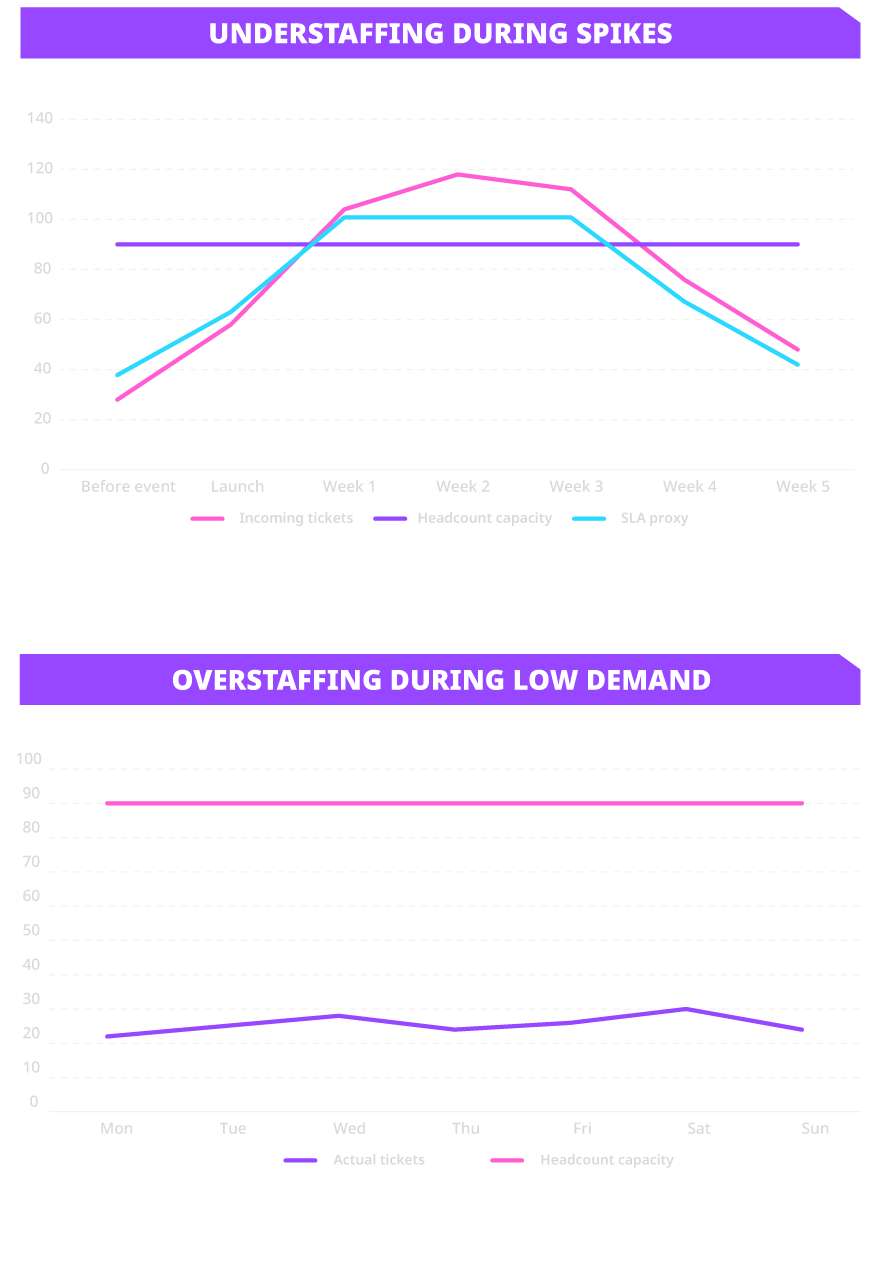
The result is a model that's inefficient at baseline and brittle under pressure – and many studios have simply accepted it as the cost of doing business.
The DRA Model
Dynamic Resource Allocation (DRA) in Player Support is a model built to solve that tension. At Side, the model runs on two layers:
- A fixed core team that handles predictable, day-to-day volume.
- A pre-trained flexible talent pool that activates when demand rises and stands down when it drops.
Staffing adjusts in intervals as short as 30 minutes.
Capacity is deployed through skills-based routing, matched to issue type, language, channel, and region. Agents in the flexible pool are fully trained upfront, knowledge-checked before reactivation, and held to the same quality standards as the fixed team.
How It Works in Practice
At the center of DRA is a dedicated scheduling platform. When demand rises, open shifts are published in real time, as granular as 30-minute windows, and the flexible pool is notified instantly. Agents claim shifts based on availability. In urgent situations, group messaging channels are opened and capacity expands rapidly to absorb the spike.
Forecasting still exists, but it's no longer a constraint. Clients provide regular volume forecasts, weekly, sometimes daily, but the model doesn't depend on them being accurate. If volumes shift unexpectedly, staffing adjusts the same day. The focus moves from forecast reliance to continuous adjustment.
That responsiveness applies across all the scenarios live-service games regularly face:
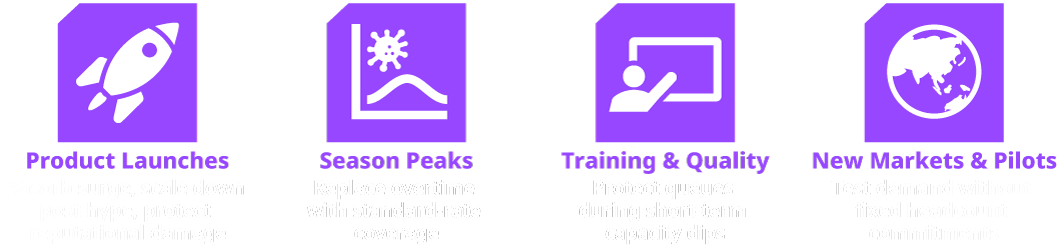
- Product launches bring sudden surges that need absorbing fast, then scaling back once demand settles.
- Seasonal peaks replace costly overtime with standard-rate flexible coverage.
- Short-term capacity dips, from training cycles or team gaps, get covered without queues taking the hit.
- For studios entering new markets or running pilots, DRA allows demand to be tested without committing to permanent headcount.
In each case, the principle is the same: capacity that moves with the game, not against it.
The Results: Efficiency and Quality
The efficiency gains are measurable. With DRA, occupancy can move to upwards of 95%. Time worked equals time on tickets, so game studios pay for productive time, not availability. By eliminating idle headcount, overtime dependency, and slow hiring cycles, the average cost saving lands at around 30%.
Quality of service also improves. DRA's target SLA is approximately one hour, against an industry norm of 12 to 24 hours. That gap matters more than it might look on a spreadsheet. In live-service, support isn't just a resolution function – it's a real-time player experience layer.
DRA reframes how studios think about support entirely. Instead of asking "how many agents do we have?", the question becomes "how precisely can we match capacity to what players actually need?" Support stops being a cost center and starts functioning as an active part of the player experience.
Quotes
Instead of asking "how many agents do we have?", the question becomes "how precisely can we match capacity to what players actually need?"
Is DRA Right for Your Game?
Like any operational model, DRA works best in the right conditions. It delivers the strongest results for large-scale live-service titles with high ticket volumes, frequent or unpredictable demand spikes, and strict SLA requirements. If your game generates significant, volatile support demand, DRA is built for that environment.
Setup takes a few weeks and works best within an established partnership. It requires upfront investment to build the trained flexible pool, integrate the scheduling infrastructure, and align quality standards. The payoff is a support operation that can move as fast as your game demands.
Make Support a Competitive Advantage
DRA won't solve every operational challenge. But for live-service games facing volatile demand, it completely changes what's possible: near-100% occupancy, ~1 hour SLA response times, and a support model that moves with your players instead of against them.
Want to see how DRA could work for your game? Get in touch with our team of Player Support industry veterans today.