For game studios releasing globally, localization is a decision based on revenue and community-building potential, much more than just a nice-to-have. And like any complex production process, the quality of the output largely depends on how well it’s managed.
This is where many studios run into problems. Not because they don’t care about localization, but because nobody fully owns it. The work gets handed to whoever has capacity, or split across vendors who operate in isolation, managed reactively instead of strategically – creating gaps across the wider game production workflow.
These problems don’t always surface immediately, but by the time they do, the cost of fixing them is already much higher than the cost of preventing them.
That’s why today we’re exploring the importance of Localization Program Management: what it looks like when someone owns the whole localization chain, how it differs from traditional project management or account management, and why that distinction makes all the difference.

The Risks of Outsourced Localization
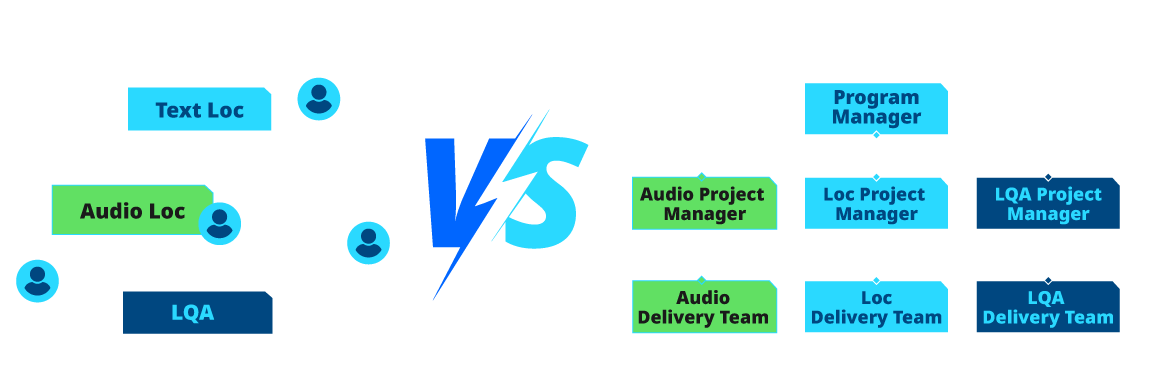
Localization is a multifaceted process that can be broken down into three categories: Text Localization, Audio Localization, and Localization Quality Assurance (LQA).
Like any other aspect of game development, doing it professionally requires a team of specialists across each discipline; however, many studios don’t have a dedicated internal team to manage and deliver these components. Without a AAA budget, it can be hard to justify.
The default solution is often to hand outsourced localization production off to an available production manager as an added responsibility. That means sourcing, onboarding, and managing vendors for translation, audio, and LQA on top of everything else on their plate.
The Problem with Siloed Vendors
Outsourcing to multiple vendors means managing different workflows, different quality standards, and communication systems all at once. As a result, these constraints can force you to handle tasks sequentially. When something changes – a script rewrite, a new language added mid-production, LQA flagging issues – that information doesn't automatically travel between teams. It falls to the PM to chase it down.
But managing a full localization pipeline is a project on its own. It requires a depth of operational knowledge that takes years to develop, and without it, gaps don't get caught. The result is a process that's inherently reactive, filled with bottlenecks that rack up unforeseen costs and put production at risk.
What Is Localization Program Management?
What exactly is a Localization Program Manager, and how are they different from a PM or Account Manager? While the roles are similar, the differences can have a major impact on your localization workflows:
- In the context of game localization, PM usually stands for Project Manager (often used in Localization) or Production Manager (often used in Audio Production), and both roles own specific deliverables – a single game title or a batch of audio or text languages on a project. Their focus is execution: managing linguists or voice actors, hitting milestones, and clearing the immediate pipeline. They’re experts in their assigned scope, but their visibility typically begins and ends with those specific tasks.
- An Account Manager is more relational, focusing on the client partnership, overseeing contracts, renewals, and high-level expectations. They’re your primary point of contact for the big picture of the business relationship, but they’re not embedded in day-to-day production.
- A Localization Program Manager operates somewhere between the roles above at the strategic level. Rather than owning one task or one relationship, they manage the entire localization ecosystem. As specialists who understand how text localization, audio localization, and LQA interact, they can predict how a change in one ripples across the rest. Typically, the Program Manager is the primary bridge between the development studio and every localization phase involved – effectively acting as a specialized in-house localization producer would.
In practice, that means mapping dependencies, forecasting budgets, and identifying risks before they surface. It means overseeing workflow governance across all three areas, coordinating terminology and glossary consistency, having oversight of VO casting and recording schedules including pickups, and ensuring LQA has everything it needs to test properly and on time.

How a Localization Program Manager Changes the Game
When text, audio, and LQA operate under a unified service, what you're really getting is an entire team that's cohesive and agile – and a single point of contact who owns all of it.
This unity creates maneuverability. Because every discipline operates within the same framework, the pipeline bends instead of breaking. When something changes (and something always does), everyone adapts in real time, leading to fewer bottlenecks. VO or translation work can begin on one language while another is still in progress. When something needs to change, it does so cleanly, quickly, and without derailing everything downstream.
The feedback loops that come with integrated oversight also make the whole operation sharper over time:
- LQA testers can ask for in-context clarifications.
- Insights and lessons learned at every stage are shared across teams, driving continuous improvement across translation, audio, and LQA.
- Translators receive meaningful feedback from people actually playing through the game.
- Terminology stays consistent across every phase of localization.
The result is better transcreation, a more immersive player experience, and a final product that reflects the same care in every language it ships in.
And because streamlined processes eliminate the inefficiencies that siloed approaches create, the cost savings follow naturally. Less time fixing problems late. Less budget lost to miscommunication. More resources where they actually matter.
Quotes
“If the goal is a better player experience, everything depends on how well information flows. When teams are connected, issues are caught earlier, feedback and proper context are shared, and the final game feels more consistent in every language.”
One Program, One Partner
Side offers Localization Program Management expertise covering every stage of the pipeline with one point of contact and one integrated team. Not only that, but our Program Managers are equipped with a deep understanding of our AI and Machine Translation program workflows, further eliminating the need for a separate point of contact.
Our quality standards and shipped projects across localization and audio speak for themselves, refined over 30 years in the industry. We’ve supported a combination of Localization, Audio Loc, and LQA on countless globally acclaimed titles of the last decade, including Kingdom Come Deliverance II, Indiana Jones and the Great Circle, Like a Dragon: Infinite Wealth, and LEGO Star Wars: The Skywalker Saga.
No more coordinating between vendors, chasing updates, and wondering whether your teams are working from the same page – that's what we're here for.
Get in touch to learn how Side's localization program management can streamline your production.